Wednesday, July 9, 2008

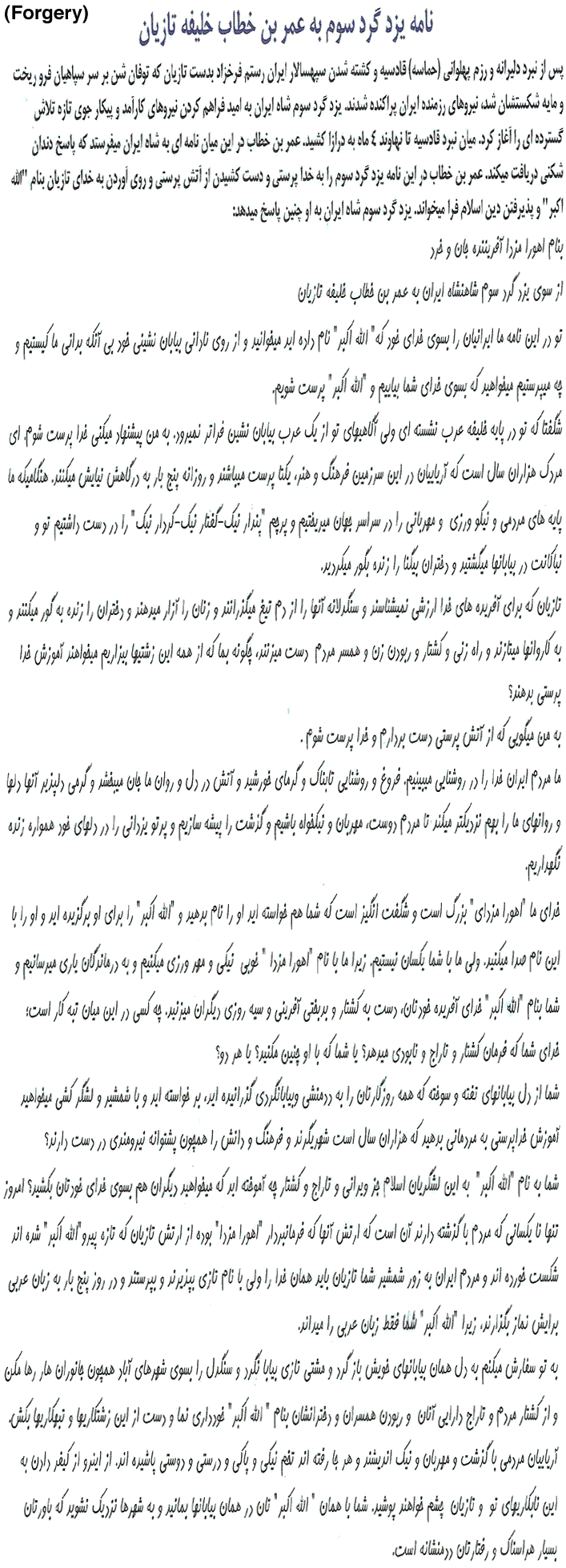
Faking Yazdgerd, Anti-Arab forgery

An expert's review of the two letters circulating the internet and emails for more than two years. the letters are said to be corresponded between Omar Khatab and Yazdgerd the third.

Khodadad Rezakhani
January 26, 2005

"The Letter of Yazdgerd III to Caliph Omar" is one of the many urban legends circulating the internet. I have personally seen four different versions of this letter, their tone and content differing from quite absurd and offensive to more believable and somehow historical. This text fits somewhere in the middle of these two extremes.

Sunday, July 6, 2008

Article

Iran and Obscurities of the Demographic Distribution in Ahwaz

This article has been written by Mohammad Nawaseri in February 2007. Considering the importance of what this article contains it is translated from Arabic to English as another step to revealing the facts about Iranian policy regarding Al-Ahwaz.


Translated by Selma Ahwazi
2008.07.06


Of the most important achievements of mankind in the twentieth century, the period of modernism and postmodernism, is the irreversible demise of the great empires which were formed after the Renaissance in Europe and Asia on the ruins of the colonized nations.

Those empires colonized the lands and enslaved the people in the ugliest forms of exploitation and slavery. However, by the end of the age of invading artillery, the method which the newly established systems who inherited the remains of those empires applied in dealing with the indigenous people of the colonized lands was the systematic nationalist policies from ethnocide to cultural dispossession, mass displacement, and ethnic cleansing against these people.
The prime motive of those empires was the economic interest justified by political and religious ideologies sometimes or by human rights and ethical issues at other times as were the Napoleon Bonaparte’s occupation of Egypt and/or Russian and British occupations.

The Soviet Union which collapsed in the early nineties is another example of those empires. It was called the prison of peoples, and its essence was exactly that of previous empires. However, people were finally liberated from this great empire which was built on fire, blood, international conspiracies, and rampant lawlessness.

Yet another example of those bloody historical empires is the Iranian Persian Empire which, since its very first inception, has been founded on colonial expansion and economic exploitation of the neighboring nations. Of the devastating consequences of those ambitions it was Arabs who suffered mainly; and it was due to the geographical proximity, and the Persian heritage that carries a deep historical hatred against the Arab nation. However, the ideological basics of this empire, which is of the remnants of the colonial past, have changed a lot through the different stages of history. In a time of some previous Persian monarchies Persian race was the main ideological motive. For the Islamic Republic, however, the Safawi sectarianism and the Persian ethnic are the main motives. It should be reminded, of course, that the contemporary Persian Empire emerged as a result of the colonial complicity in the twenties of the last century and the geostrategic repercussions of the Bolshevik revolution in Czarist Russia then.
The first victim of the newly emerged Persian empire and its chauvinist attitude against the geographical proximity in general and the Arab neighbors in particular is the Arabian state, Arabistan (Al-Ahwaz), which was occupied on the 20th of April of 1925. Arab rule was abolished in this historically Arab region due to its geographical nature; as Al-Ahwaz is considered the Eastern Gateway of the Arabian lands.
The forces that helped caesarean of the Iranian empire - modern Persian- are the same forces that played a key role in undermining Arab rule in Ahwaz. One of them was the British Empire which had colonial ambitions in the Arab countries in that dark era of history.
Of other influential parties was the sectarian Safawi establishment men of which, such as Mirza Naeeni and Aboulhassan Isfahani, are famous for their contributing fatwas (religious opinions and rules). They played a key role in the preface to the occupation of Ahwaz. There were also politicians, intellectuals and the Zoroastrians of Iran and India who were working in the government of East India Company. People such as Ardeshir Chi and Arbab Keikhosrow as well as racist thinkers like Mahmud Afshar and Kazem Zadeh Iranshahr.
It is not a coincidence that these same parties played a key role in the occupation of Iraq in 2003, where the sectarian Safawi establishment is represented by men like Sistani and Hakim and other men of religion in Iran, and as before, Britain and her confederate, America, who is the most prominent heir to the British colonial past.
One of the most important historical factors that have led to the cooperation between Persian Empire and the Western colonial powers in the past and present, in spite of the ideological differences between them, is the historical hatred of both against Arab nation. Though enjoying strong military forces and a great civilization, Persian Empire was not lucky in her wars against the Arabs for the winner was always the Arabs. Arabs triumphed over the Persians in 310 AD and killed their king, Hormuz II. Moreover, they were victorious in their battle of Dhi Qar in the early seventh century AD, when several Arab tribes (from Iraq and Ahwaz), who were led by Bani Sheiban, allied against the Persians.

This battle was so important that the prophet Mohammad commented about it “Today Arabs won their rights from Persians and evened.”
In the battle of Qadisiya in 635 AD Arabs, led by Sa’ad bin Abi Waqqas, won again. They wiped out the Persian armies led by Rustam, while Na’man bin Moqren was their leader. And eventually, after winning the Nahawand battle, led by Hudhayfah ibn Alyaman in 642 AD, Arabs conquered Persia, and banned Zoroastrian religion there, and Persians admitted Islam as their religion eventually. Arabs were victorious in their several battles against Persians in the era of Moshashaeen, Arabian government of Ahwaz in the sixteenth and seventeenth century. Another victory for Arabs happened in the era of Bani Ka’b in Ahwaz with the leadership of Sheikh Salman Al-Kaabi in the eighteenth century.

The security conditions and political history of the Arab nation in general and southern Iraq in particular, are the same circumstances which Ahwaz went through before the occupation in the twenties of the last century.
Blatant interference of the Iranian occupation which is represented by the Iranian security agencies[1] and the sectarian Safawi policies in various aspects of daily and/or political life is a preparation for uprooting this important and vital part of the body of the Arab nation and its natural extending with the ambition to attach it to the Iranian body. It was the same policy that paved the way for the occupation of Ahwaz, as this Arabian country was a rebel against the British and Persian and Osmani (Ottoman) empires up to the forties of the nineteenth century. After the Osmani’s broad attack in alliance with the Al-Montafaj Sheikhdom which led to the destruction of Muhammara, the capital of Ahwaz, Sheikh Jabir, sheikh of Ahwaz in that time, was forced eventually to request for help from the Qajarite government. The result was the second Ground Rum Treaty in 1847, which classified Ahwaz under the influence of the Iranian empire, compared with a waiver claim on Iran's claimed influence on some other areas such as the banner of Sinjar and Sulaymaniya. The religion factor played the main role in that treaty, which culminated in the colonial military occupation of Ahwaz in April 1925. Drawing her lessons from history, Iran exercises the same policy in order to single out Iraq and pounce upon it to exploit and plunder its wealth after that she lived and still lives for eight decades of occupation on the wealth of Ahwaz while denying Ahwaz’s citizens the most basic necessities of a free honorable life.

Systematic policy against Ahwazis

The policy of the Iranian regime towards different nations in Iran in general and Arab people of Ahwaz in particular -after the direct military occupation-, was and still is systematic at various levels. These racist inhumane policies aimed at the political, cultural, social and economic structures of this nation. Their objective is melting this people in the Persian crucible through obliterating their Arab identity, which is represented in the language and national culture, and eventually uprooting them of their Arabian roots and of the land they lived and took root in for thousands of years. Such policy was always systematized and applied by the political authority in Tehran.
This policy began with the occupation of Ahwaz, and Reza Shah Pahlavi put the first building blocks of it by granting the Arab’s lands to the military men of Persia, and the men of politics, administration and security. Moreover, he withdrew the ownership of the remaining lands from the Arab farmers and gave them to Natural Springs Foundation in order to facilitate the confiscation of those lands in the studied future steps. He also displaced hundreds of thousands of the farmers and citizens to the central parts of Iran, Iraq and the Gulf states.

This policy was continued by Mohammad Reza Pahlavi, the son, and it became even more brutal because of the Persian racial orientation and its hatred against Arabs. Through the land reform policy in the sixties of last century, specifically in 1963, and under the title of agrarian reform and white revolution, hundreds of thousands of agricultural lands were confiscated and then entitled to the Persian settlers. The first of these was the project of sugar canes, which inaugurated in that period on the ruins of dozens of Arab villages in Ahwaz.
Those criminal policies culminated after the arrival of the clergy to the power, specifically after the end of the Iran-Iraq war. The nature of the ideological composition of this government had the prominent role in the development of the vicious circle of this policy which comprises the terms of sectarian extremism, historical hatred, and the Persian racism and hostility against all that is Arabic.
The strategy of this policy was codified under the rubric of the demographic distribution under the circular issued by the Supreme National Security Council headed by Hashemi Rafsanjani, under the number 971 \ 2 b -3416 and the date 14. 04. 1371 Hijri- that is 1992.07.05- and also the circular issued by the Office of Mohammad Khatami as the General Secretary of the Supreme National Security Council, number 27686 \ 12 and the date 01.05.1377 - that is 1998.07.23.

Results of some of those racist policies

- Confiscation of more than 70 thousand hectares of agricultural lands in areas such as Al-Shuaibia, Al-Minaw, Susa and northern parts of Ahwaz to the advantage of companies the most important of which are Iran Cultivation and Manufacture Company – Iran and America Cultivation and Manufacture Company - California Company, DezKar Company, Shell Company, Klassno Company and other American and Israeli companies during the reign of Mohammad Reza Shah.
- After the success of the Iranian revolution, more than 135 thousand hectares of lands belonging to Ahwazi farmers in southern part of Ahwaz city and northern part of cities of Muhammara and Abbadan and on both sides of Karoun river have been confiscated. These lands are of the most fertile agricultural lands in Ahwaz, and they all were confiscated with the pretext of setting up the Sugar Canes Project, while the companies instituted on this project belong to the men of the Iranian government and the ruling denominational Safawi institution in Iran.
- Confiscation of 47 thousand hectares of Ahwazi Arabs’ lands for the purpose of setting up the project of the disabled of Iraq-Iran war in Jufair near to the Iraqi-Iranian borders.
- Confiscation of more than 25 thousand hectares of Arabs’ lands for the purpose of setting up the project of fish farms in south of the Ahwaz city. These lands were granted to the Persian settlers who were of the newcomers to the territory.
- Confiscation of more than 100 thousand hectares of lands in the east of the Huwaiza town extending to the north of Al-Muhammara city under the pretext of military maneuvers of the 92 Army, and very obviously the whole of that area is an agricultural land. Several Arab villages there were inhabited by thousands of Arabs who were finally displaced from their lands by force.
- Confiscations of thousands of hectares of agricultural land in cities of Al-Khafajiya, Al-Huwaiza and Al-Besitin under the pretext of developing the Azadegan oilfields which extend to the Majnoun oilfields in southern Iraq; Japanese companies oversee this project.
- Confiscation of more than 6 thousand hectares of agricultural land in the city of Susa, and granting them to the military men of the Revolutionary Guard and Ghods Forces. This project is called the settlement of the clergy in the north and northern-east of Ahwaz province. The confidential document of this project eventually leaked out. The document is called the Sardar Rasheed document; and Sardar Rasheed Is one of the senior commanders of the Revolutionary Guard and Ghods Forces.
- In addition, there is the entire demolition of Arabian areas and displacing thousands of Ahwazis under the systematic policy with the purpose of turning the demographic distribution in Ahwaz, such as the demolition of Sepidar neighborhood in the city of Ahwaz in 1998 and displacing the people of this district who are mostly of the lower economic class.[2]

- Beside the policy of land confiscation, a parallel policy against Ahwazis is being practiced by Iranian government which is not less vicious and racist than the former, and that is perverting the main river courses in Ahwaz such as Karoon, Al-Karkha, Al-Jarrahi and other rivers, and stealing the water and pumping it into central Persian areas such as Isfahan, Yazd, and Kerman for the purpose of irrigation. This happens while they deprive the Arab farmers of these waters and make their fight for living more difficult and more frustrating. Moreover, periodically they fabricate floods through the dams that have been constructed for this purpose, in order to demolish the infrastructure of Ahwazi villages, and consequently facilitate the displacement of Arab people and confiscation of their agricultural lands and demolition of Arabian villages and countryside of Ahwaz.

The purpose of all this is the displacement of the farmers from their villages and systematic destruction of their economy and their enrolment in suburban marginalized areas, that are called ”the Arab belt of poverty”; and then besiege of the Arab towns with Persian settlements and towns that have been established for this purpose and there are dozens of them, such as “Shirin Shahr” Settlement in the south of Ahwaz city, in the midst of the villages that have been destroyed for The Sugar Cane Project and fish farms. This settlement is designed for more than ninety thousand people as a first step to be widening. There is also the giant “Ramin” settlement in the north of Ahwaz city, which is built for more than one million settlers from the Persian newcomers to the Territory.

Marginalization of “the Arab belt of poverty” is a deliberate and planned process, where poverty, addiction, crime, and all kinds of structural imbalances at the level of cultural, social, and economic structures spread widely. Living on the margins of the society is a normal secretion of these inhuman policies. Of the most important implications of this policy are the environmental disasters, water pollution, increasing salinity in the land, environmental pollution and spread of infectious diseases, and all these complications are mentioned in the report submitted by ”Milan Kothari”, United Nations’ envoy to the province, less than three years ago. In this report he describes these policies as catastrophic for the indigenous Arab people of Ahwaz.


Escalating policy of confiscation and settlement

These criminal policies are escalating and being accelerated during the past fifteen years, and they were highly applied especially during the presidency of Hashemi Rafsanjani and Mohammad Khatami after that the crew of technocrats (the group of Kargozaran-e-Sazandegi) -with Persian tendencies and orientations- became the authority of development projects in Iran. During this period tens of thousands of hectares of fertile agricultural land in various towns of Ahwaz were confiscated, under the political plan known as “settlement demographic distribution”.
After coming of Ahmadinejad and his “Hojjati” crew to the rule, these policies peaked. This was especially after the outbreak of Intifada in 15th of April 2005 and it was a collective punishment of Ahwazis for their steering disobedience against the Iranian military occupation. The evidence of this is the starting of the confiscation of 30 thousand hectares of agricultural land in the cities of Ahwaz, Al-Khafajiya, and Al-Hindian (Al-Tamimia). This plan is mentioned in the assessment report issued by the Department of Fisheries in the territory.

This plan contains:
Beginning the second phase of the Ahwaz “Azadegan” project (NDC) which will eventually end up with the confiscation of 12400 hectares of Arabs’ lands. In the first phase of this project 25 thousand hectares of these lands were confiscated.
Beginning of a project in Al-Khafajiya which will cover ten thousand hectares of lands.
Shrimp breeding project that covers 8 thousand hectares in the east and west of the river “Zahra” in the city of al-Hindian (Al-Tamimia).
The establishment of ports in Bahrakan area of Al-Indian and Nahrolghasir River in Abbadan and more other ports in other spots. This has been known that these ports are not subject to the authority and control of the Ports Department; they are rather exploited and utilized by the Revolution Guards (Sepah e Pasdaran) for smuggling and circumventing the international resolutions against Iran in banning the importation of weapons. These ports are important because they are located near Iraq and the Gulf States.

The objectives of these policies

There are economic, historical, political, and security tendencies behind these systematic structural policies against the Arab people of Ahwaz.

With a closer look at the political map of Iran and its Arab neighbors, we notice that the lands that were confiscated in the north-west and west and south of Ahwaz are along the Iraqi and the Gulf States borders. The purpose, however, is to facilitate the process of Iranian intervention in the internal affairs of these countries away from the eyes of Ahwazis and to create a military logistical environment to provide protection and adequate supply for the Iran’s continuing interference in the affairs of these countries.
Moreover, emptying these areas, in which lie the largest fields of oil and gas, from Ahwazis as a first step, and titling them to the Persian settlers and newcomers as a step forward is Iran’s main policy in order to change the population composition of the Territory in favor of the Persians and the central government, as all the successive governments of Iran have maintained this policy since the formation of the Iranian state, or rather the modern Iranian empire, at the hands of Reza Khan.
Among these goals is also the dismemberment of the Arab people of Ahwaz and isolating and sieging them in their towns and villages and depriving them of any connection with the Arab world, through Iraq and the Arabian Gulf, which was naturally easy due to the strategic geographical position of Ahwaz.
And this explains the breadth of the policy of land confiscation and mass displacement which was stated in the document that was leaked out from the Office of Khatami. That document, with the accumulation of contradictions and with the overall conditions, caused the Intifada of the April 15th the result of which was hundreds of martyrs and wounded while thousands of people have been arrested and 12 people so far have been executed, and the list is growing[3].

This plan also included the areas in the north, the middle, the east and south of the territory. This is the most serious ever, and was disclosed by the document mentioned above, under the title of the industrial and commercial draft of Arvandan in the cities of Muhammara and Abbadan, for which reason hundreds of thousands of Ahwazi Arabs will be displaced from their towns and villages that fall within the scope of this large settlement project and so dozens of Ahwazi villages will be demolished.
In addition, there has been the displacement of more than 300000 Ahwazi citizens from the cities and countryside of Muhammara and Abbadan during the Iran-Iraq war who did not return to their villages which they had abandoned due to the destruction of infrastructure, lack of services, and spread of minefields in those areas and all are the remnants of the war. The Iranian government went to no action for clearing the minefields in order to prevent Arabs from returning to their villages and leaving their exile zones in northern and central Iran.
In conclusion, this must be emphasized that all these criminal policies, which are of course applicable to the concepts of mass displacement and ethnic cleansing and major crimes punishable by international law, are implemented before the eyes and ears of the Arab States and the international community who ignore the Ahwaz tragedy claiming that it is an Internal issue and is part of the concept of sovereignty.
Nevertheless, one who follows the events prudently is to note that Ahwaz was not Iranian ever, it is an Arabian land occupied with brutal force since 1925, and the most prominent evidence of this is the successive uprisings of its Arab citizens against the different Iranian governments during the last 83 years. Ahwaz is a region for which its Indigenous Arab people are fighting against the Iranian occupation authority. And this is what all Ahwazi national resistance parties are unanimous in, despite their various beliefs and different ideas. Accordingly, the need for Arab and international intervention in this regard is clear in order to tame this arrogant Persian monster and save the Arab people of Ahwaz from the policy of ethnic cleansing, and to stop the Iranian interference in the internal affairs of Arab countries under the pretext of sectarian Safawi Purism at one hand, and preserving the Persian vital interests and national security at the other hand. The aim behind this is hegemony, which is an integral part of the mentality of Persians, clericals they are or seculars.

[1] Iranian Intelligence, Sepah e Pasdaran (Ghods Army), and Iraqi security agencies which were formed in Iran, as Bader Forces. (translator’s note)
[2] Also, 25 houses in the Arab area of Hasir Abad in Ahwaz were destroyed in May of 2008.(translator’s note)
[3] Many more Ahwazi people have been executed since the time of this article.

Friday, June 20, 2008

World Refugee Day 20 JUNE


A Day to Remember Refugees in Syria

Written by Najla Ahwazi

Today is World Refugee Day, a day of remembrance and recognition of the world’s refugees, of whom there were an estimated 11.4 million in 2007, according to the office of the United Nations High Commissioner for Refugees (UNHCR). Some groups number in the millions—like the 3 million Afghans mainly in Pakistan and Iran, or the 2 million Iraqis in Jordan and Syria. Other groups are much smaller, like the few hundred Ahwazi refugees in Damascus, Syria.

While the number of Ahwazis in Syria may be small, their protection concerns are not. Syria, despite its “Pan-Arab” philosophy, maintains tight and secretive relations with Iran. Iranian refugees in Syria are continuously harassed, followed, intimidated, and jailed—not for transgressions against the Syrian state, but for their political activities and opinions in Iran. Last December, four Ahwazi refugees were forced to flee Damascus to seek asylum for the second time, this time in Lebanon. They had been threatened with extradition to Iran, as well as attacks on them and their families. UNHCR, much to its credit, accepted these men once they reached Lebanon, and agreed to continue processing their cases for third-country resettlement. Their cases remain pending.

Other Ahwazi refugees in Syria are not so lucky. In May 2006, Syrian authorities deported several Ahwazi refugees plus a Dutch national of Ahwazi origin; the men were arrested upon return, and according to friends and family in Iran, severely tortured in prison, where they remain, pending execution. Despite the international outcry over Syria’s deportation of these recognized refugees, the damage was done, and Syria’s blatant violation of the principle of non-refoulement of refugees barely acknowledged.

Then, in March 2007, Syrian agents rounded up six young Ahwazi refugees and held them in one of many secret security detention facilities in Damascus. After forty days’ incommunicado detention, the authorities suddenly released five of the men, who were then resettled to a safe third-country. The fate of the sixth young man remained unknown until the end of the year, when he too was suddenly released and allowed to be resettled well outside of Syria. For nine months, however, neither UNHCR nor the family of the 21 year old man were allowed access to him, or even acknowledgement that he was still alive, or even still in Syria.

Again, despite international attention to this case and attempts at many levels to secure information and release of the detained men, Syria’s harassment of Ahwazi refugees continued unabated. A month later, another Ahwazi refugee was arrested at the airport as he prepared to board a flight to a safe third country. He was held for several weeks, and then suddenly released. His case for resettlement had been pending departure for more than six months, held hostage to slow processing and inadequate attention being paid to Ahwazi cases in the Damascus office of UNHCR.

Then, in the early morning of 5 March 2008, a 31-year old Ahwazi refugee named Saeed Hamadi was about to depart for resettlement when he too was arrested at the Damascus airport. The five Ahwazi men who were there to see him off were likewise detained and questioned, but unlike Saeed, not arrested. Saeed disappeared into one of Syria’s detention centers, where he remains, more than 100 days later. Requests by UNHCR to Syrian authorities have fallen on the typical deaf ears of the regime. Appeals to the UN and International Red Cross/Red Crescent have not produced any information, or acknowledgement of his continued detention. No information is forthcoming, so his friends and family wait, uneasy.

Syria’s arrest of departing refugees not only violates the very nature of refugee protection, it also circumvents the mandate and work of UNHCR to protect the most vulnerable from persecution on the grounds of political opinion. The regime’s targeting of Ahwazi Arab refugees is also ironic, given Syria’s own political ideology espousing pan-Arab solidarity. That a non-Arab state, Iran, is manipulating the actions of this Arab strongman, is disturbing. That the Arab League is mute on the topic of human rights violations against Ahwazi Arabs is shameful. That Ahwazi Arab refugees have no safe haven in Syria—and few alternative places to which they can flee persecution—is unacceptable.

On the day he was arrested at the airport, Saeed Hamadi had a plane ticket, valid entry and travel visa for his destination, and exit permission from the Syrian authorities themselves. He committed no crimes in Syria—and none anywhere else for that matter. Quite the contrary: while in asylum in Syria, Saeed was a leader in his community, tirelessly and selflessly looking out for the most vulnerable Ahwazi refugees.

Saeed Hamadi deserves our thanks for his work as a community leader and liaison. He has the right to protection from persecution, in a place where he can live in security and dignity, without the threat of harassment, arrest or execution for his support of minority rights. On this World Refugee Day, Saeed Hamadi should be safe and free, perhaps working or studying a new language, in his new country. Instead, he remains illegally imprisoned, somewhere in Damascus, for no crime beyond being an Ahwazi refugee in Syria. Saeed, like too many others, became the victim of the Iranian regime’s manipulation of rumor and scare tactics, designed to suppress the Arab minority even after they’ve left Iranian soil.

UNHCR’s World Refugee Day campaign for 2008 states, “Millions of refugees live in urgent need of protection. Remember them today.” We remember Saeed Hamadi, and look forward to the day, hopefully soon, when he’ll be released from prison and safely resettled far from Syria and Iran. We just hope that no other Ahwazi refugees are arrested in the meantime, or ever again.

The Ahwazi Arab Struggle and International Reactions

Source

Although all Iranian citizens suffer political repression and serious restrictions on freedom of expression and assembly, state violence against Ahwazi Arabs is more extreme than against critics in Tehran. Any form of Arab political mobilisation has been crushed, with the government executing anyone suspected of engaging in minority rights activism.

Ahwazi Arab minority rights activists are portrayed by the Iranian government as representing all that it regards as "evil". The government and its supporters routinely denounce Ahwazi rights activists as Satanic, Wahhabi (Sunni extremists), Ba'athist or agents working on behalf of the Israeli, British, US or Saudi governments. Although Ahwazi activists campaign against social, cultural, economic and political exclusion, the government insists they have a religious agenda that is antithetical to the theocratic establishment, the "source of truth." Consequently, Ahwazi dissidents are often put on trial for "enmity with God", which is punishable by death.

Yet, the Ahwazi Arab struggle has been marginalised by exiled opposition groups, such as the monarchists, republicans and even some communists. This is, in part, a legacy of the Pahlavi dynasty's racial nationalism. These "opposition" movements have often declared that they would stand beside the current regime against Ahwazi Arabs to prevent what they see as the destruction of their country by an "alien" race, even when Ahwazis themselves do not advocate secession. Often, supporters of these movements seek to play down the suffering or Ahwazi Arabs or the importance of their struggle to freedom and democracy in Iran, and have lobbied international human rights organizations to eliminate all mention of ethnic discrimination.

Ahwazi Arabs also have few friends in the Arab world, although there is growing recognition of their suffering by some Gulf states such as Kuwait. As they are predominantly Shi'ite, Ahwazis elicit little sympathy from their Sunni Arab brothers. Moreover, many governments in the region are careful not to upset the militaristic and aggressive power lying to their north, viewing the Ahwazi issue as a struggle that could cause them unnecessary problems were they to be involved.

In the international community, the British government, members of the House of Commons, the European Commission and the European Parliament have condemned ethnic discrimination against Ahwazi Arabs and other national groups. However, they have concentrated on individual cases of human rights abuse against Ahwazi Arabs, particularly the use of the death penalty, rather than broader issue of ethnic persecution. British government ministers have voiced concern that any proactive stance could cause more problems than it would solve, confirming Iranian propaganda that claims the British government is funding, training and arming separatist organizations. Neither the UK nor the EU have endorsed the Ahwazi Arabs' right to self-determination or the Mohammerah Declaration of 1979, which embodies the aspirations of Ahwazi Arabs. Yet, if the Iranian regime is to be prevented from driving the Ahwazi people literally off the map, then it's vital that their predicament be placed firmly on the 'political map' here in the West as well as the Arab world. Ahwazi Arabs can neither rely on their Iranian compatriots nor their Arab brothers for support. International solidarity is therefore essential to ending their persecution.

Sunday, June 15, 2008

Al-Intifada, Racism or Nationalism?


A reader, who is not an interested party, may find the posts of this weblog biased and even racist. Well, to begin with, one should consider that when I talk of the racism practiced in Iran, I can not mean only the one practiced against Ahwazi people (though I especially mean that). Racism in Iran is practiced against all of non-Persian ethnic groups living in different parts of Iran. I am not going to go into details of this racism. The case is that when I write in my Arabic weblog in Maktoobblog.com some of Arabs from different countries put comments like "what's your problem with such nice Islamic country?!", or "Come on, we are fed up with Al-Orouba(Arabic Identity)", or "Why don't you Ahwazis just live in peace with Persians, why should you be so racist?".
The worst thing that they could say is about Iranian government being an Islamic one! I really love to see Syria or Egypt go under the control of Ikhwan-Al-Muslemin, so that after tasting the secular dictatorship, get stuck with its Islamic version and then it will be a really interesting story.
Then they talk about us being racist? Of course, I do not expect from Arab nations, who live in censure and ignorance their whole life, to understand our situation. But then what becomes of the scholars? What is the position of Arab Scholars when the question is Palestine? Do they call Palestinian resistance against whatever Israel does to them Racism? Or maybe Israel-Palestine issue is the only one understandable to many of Arabs?
Arab Scholars should go and do some readings to see what really Persian theoreticians and thinkers write about them. People like Zarrinkoub, Safa, Afshar, and many more, are only some examples of Persian racism taught in the universities under the name of history and literature.
On the contrary, we Arab of Ahwaz, live among Persians, marry them, befriend them and communicate with them in all of possible ways. And yet, our Arabic race is a brand on our foreheads to let them recognize that we are different, we are the barbarians, we are the ignorant, we are the enemy, and we are the one whom they should watch and not let move. How is an Ahwazi expected to react? The history of human being reveals that the one who keeps silent in front of oppression is doomed to death and abolition. And this is not something I need to repeat for the wise reader. However, I need to emphasize that raising against discrimination cannot be considered racism itself. If I do not talk for my people, if I do not write about their sufferings, then who should do that? And, moreover, with this little weblog, or other few Ahwazi websites, can we even be counted in front of the huge media of Iranian type that advertise for them day and night? Under suppression the most trivial steps of a small forgotten group of people towards freedom count. This movement takes different shapes. For Ahwazi Arab people it gets the shape of nationalism as the only way possible towards freedom, and it is in no way racism. Racism is for the dominated group. Power brings racism. And for the minority group having something in common is only a motivation, an excuse for movement. How can the nationalistic view of a powerless group under oppression be felt in any way racism?
Which represents racism to a fair eye, Palestine, or Israel? Let Arabs remember this when they want to comment on the peaceful human demands of Ahwazi People for their rights.


http://www.youtube.com/watch?v=i8UXzSIyGyI

Wednesday, April 9, 2008

AN INTERVIEW WITH ALIREZA ASGHARZADEH

Source: www.durna.eu
various non-Persian ethnic groups in Iran have no animosity against the dominant Persian group. All they want is to be treated equally as equal citizens of their country. It is only the elites of Persian group and their culture that constantly humiliate other groups as subhuman, lacking in culture, lacking in civilization, lacking in linguistic abilities, and so on. For instance, the Persian culture identifies Turks as donkeys (Tork-e khar); it identifies Arabs as dogs (Taazi), and so on and so forth. It bans the languages of non-Persian groups and seeks to supplant them by its own Farsi language. Obviously, here we are dealing with a racist and colonial condition in which one group dominates others.

INTERVIEWER: Lisa A. Hamdoon, University of Toronto


Lisa: I have just finished reading your book, Iran and the Challenge of Diversity: Islamic Fundamentalism, Aryanist Racism, and Democratic Struggles, and must say, am quite impressed. I mean, this book is nothing like the others on Iran and the Middle East. In general, I never find the work coming out of Middle East departments to be critical. Is your work critical because you work outside conservative Mideast departments? Can you tell us what makes your book so different?


Alireza: Thank you Lisa. My work is critical for many reasons. First of all, I am deeply rooted in the critical tradition of social scientific research and consider myself and my work to be a part of this rich tradition. I have always valued critical thinking and reflection, and try to illustrate this through my work. Secondly, the environment is of course very important. If you work in environments that stifle critical reflection, if you work with individuals who do not know the first thing about critical thinking and freedom of expression, of course you won’t be able to produce critical work. If you work in the departments which still espouse positivistic research methodologies of the 1940s and 1950s, of course you won’t be able to do anything of significance. Such methodologies usually consider praising of the dominant order (e.g., patriarchy, racism, sexism, nationalism, nation-statism, the homeland, the nation, the ruler) as positive, impartial, and objective research; but when you critically engage issues of marginality, systemic oppression and exclusion, your work is considered to be “emotional,” “non-objective,” “non-scientific,” etc. Maybe that is why the Middle East departments in general are not able to produce critical work. Particularly, the work coming out of these departments on Iran is for the most part a regurgitation of Orientalist and Aryanist views on Iran’s history, culture, ethnography, anthropology, philology, antiquity, etc. With the exception of a few works, you don’t come across anything challenging, different and fresh.

Lisa: Is that why some of these academics show hostility toward critical work and critical thinkers such as yourself?

Alireza: Yes, that could be one of the reasons. We have to realize that most of these individuals have built reputations for themselves around a repetition and regurgitation of Orientalist views on Iran. So when someone like me comes along and says that, for instance, Iranian is not synonymous with Persian and that Persians are but one minority ethnic group in Iran, constituting about 36 percent of the total population, these folks get furious and start calling us names, this and that.

Lisa: Recently I came across a review of your book written by Dr Kaveh Farrokh and posted on a number of Iranian sites, including one titled “Aryamehr.” The reviewer labels your work as anti-Iran! How would you respond to this?

Alireza: These kinds of labels are normally used in dictatorial environments and by individuals with extremely undemocratic mindsets. Such labelling represents a very reactionary approach to any kind of text. What does it mean for a book to be anti-Iran? Imagine that you write a book criticizing the Canadian government’s approach to Aboriginal peoples, and then someone turns around and labels your work as anti-Canada! Or someone critiques the caste system in India and is labelled as anti-India! These are fascistic methods that are used to stifle free expression and to silence the voice of dissent. My work exposes the unbearable racism and Hitlerite Aryanism practised in Iran since 1925. In any racist situation, there are those who benefit from racism and there are those who suffer from it. Those who benefit from the existence of racism and systemic oppression in Iran label my work as anti-Iran. It is as simple as that. But they are in the minority. My work speaks to the suffering and marginalization of Azeris, Kurds, Arabs, Turkmens, Baluchs, Lors, Bakhtyaris and other excluded groups such as women, workers, peasants, students and so forth. And these are the oppressed majority in Iran.

You have to realize that in all racist environments, the dominant group who benefits from racism comes to believe that it has the sole ownership over the entire country. Just as it seeks to define ‘the nation’ in terms of its own ethnicity and identity; so too it imposes its language on the entire population, masquerading it as the so-called “national language;” its history masquerades as “the national history,” its identity becomes the identity of all peoples living in that country. So if someone critiques the privileged position of this dominant group, that critique gets identified as a critique of the entire ‘nation’ and country. This exclusionary act in itself testifies to the existence of racism and systemic oppression in Iran. The way they try to intimidate us, to silence us by threatening to get us expelled from our jobs, all these McCarthyist methods show that we are dealing with very undemocratic and indeed fascistic mindsets. In my book I clearly show that this racism is not limited to the government in power but includes many writers and intellectuals from the dominant group as well. You say they identify my book as “anti-Iran” on a website called “Aryamehr.” You might be interested to know that “Aryamehr,” the site you say has published this review, in Persian means “the light of Aryans!” This title alone should suffice to expose the kind of ugly racism with which we are dealing here. So, is it any wonder that those glorifying “the light of Aryans” to call an anti-racist book “anti-Iran”?

Lisa: In addition to you, other authors and academics like Brenda Shaffer, Mehrdad Izadi, and Naser Pourpirar are also identified as “anti-Iran.” How would you comment on this?

Alireza: Brenda Shaffer wrote a wonderful book in 2002 titled "Borders and Brethren: Iran and the Challenge of Azerbaijani Identity." Through this work she studied, among other things, the impact of the independence of northern Azerbaijan on the processes of identity formation in southern or Iranian Azerbaijan. Brenda’s research showed that the independence of northern Azeris has a major influence on how Azeris of Iran (will) identify themselves. She reached a conclusion that contrary to the dominant perspective, Iranian Azeris view themselves as a distinct ethnic group within Iran. That is to say, they are cognizant of their distinct history, their language, their ethnicity, and their nationality; and they are aware of their differences with other ethnic groups such as the Persians, the Kurds, the Arabs, and so on. This was a sound scholarly observation that had been misrepresented by generations of Orientalist scholars. So when the book came out, these so-called scholars of Iranian studies started dismissing it, obviously not so much from a scholarly standpoint but for a variety of ideological reasons.

However, those of us who were active in the field knew very well that Brenda had hit the nail right on the head. Azerbaijanis were a divided nation and any development in one part of this nation would inevitably influence the other part. Now after five years since the publication of Brenda’s work, everybody can see how objective and accurate her study was; and how vacuous her attackers have been. All you have to do is take a look at what is going on in the streets of Tabriz, Urmiyeh, Aradabil, and Zanjan; see how hundreds of thousands of people came out on May 22 last year to reclaim their Azerbaijani and Turkic identity; take a look at the prisons in (south) Azerbaijan and you’ll see they are full of individuals identifying themselves as “hoviyyat-talab” (reclaimers of identity). Brenda Shaffer had hypothesized this situation several years ago, when the Azerbaijani movement in Iran was still quite invisible. If her book is not a scholarly work, then I wonder what a scholarly work is, filling of thousands of pages about Div-e Sepid, Ashkboos, Rostam-e Dastaan, and other mumbo-jumbo from the Shahnameh of Ferdowsi? Or weaving colourful narratives about “Takht-e Jamshid” or Persepolis, an Orientalist constructed Achaemenid palace that now local Iranian historians, architects and engineers prove with certainty that never existed?


Lisa: Naser Pourpirar is also labelled as Anti-Iran. I noticed you reference him quite a bit in your book. What is his story?

Alireza: Naser Poorpirar (or Pourpirar) is a very intelligent historian, and a very complex character. I respect him for his originality and his independent research, but I don’t agree with his methodology and with some of his conclusions.

Lisa: How do you mean? Can you expand on it a bit more?

Alireza: You see, in my book I explore some aspects of an emergent anti-colonial and critical historiography in the region. In Africa, for example, we have T.O. Ranger who initiates over 40 years ago the importance of writing African history from an African standpoint, based on African epistemologies and methodologies. And in India, we have the Subaltern Studies Collective, a group of researchers and scholars who come together in early 1980s and begin writing a history of India and South Asia from the standpoint of the subaltern, the marginalized and excluded. This kind of historiography is not a top-down method of history writing; it is a bottom-up historiography. And this is a major departure from all sorts of elitist, ‘nationalist,’ Orientalist and colonialist historiography. Well, in Iran this historiography starts effectively with Naser Poorpirar. For the first time in Iran’s modern history, a local historian decides to take on the challenging task of re-examining a history written by foreign missionaries, travellers, priests, ambassadors, anthropologists, philologists, and historians. And this local historian is Naser Poorpirar. No one else has done this before him. In Iran he is the first to produce a local historiography by exposing misconceptions and misrepresentations inherent in the Orientalist historiography of Iran. He has done a great job in this field and he will be remembered because of this.

Lisa: What about the problematic area of his work that you mentioned?

Alireza: You might have noticed that my book starts with a mild criticism of Edward Said’s Orientalism. I critic Said for failing to properly discuss “Aryanism.” The reason for this is, in an Iranian context we are dealing with Aryanism more than anything else. As a matter of fact, in my book I show the evolution of this concept of “Aryan race” from its inception up to the emergence of fascism and Nazism in Europe. I show clearly in the book how Adolph Hitler’s definition of this term does not differ that much from its current definition in dominant Iranian literature. In an Iranian context then, we need an interrogation of this concept of ‘Aryanism’ more than any other term. Poorpirar does not do an effective job in this area. Aryanism, moreover, was a discourse constructed to reject Judaism, Semitic races and biblical religions. It was an anti-Semitic and anti-Jewish project from the very beginning. How can such a project be manufactured by the Jews? And herein lies a major contradiction in Poorpirar’s methodology.

Lisa: Is he saying Aryanism is constructed by the Jews?

Alireza: He does not discuss Aryanism per se. He tends to indicate that the current animosity among different ethnic groups in Iran and in the region is a result of historical Jewish conspiracy. Now the way I see it, there are several things wrong with this picture. To begin with, various non-Persian ethnic groups in Iran have no animosity against the dominant Persian group. All they want is to be treated equally as equal citizens of their country. It is only the elites of Persian group and their culture that constantly humiliate other groups as subhuman, lacking in culture, lacking in civilization, lacking in linguistic abilities, and so on. For instance, the Persian culture identifies Turks as donkeys (Tork-e khar); it identifies Arabs as dogs (Taazi), and so on and so forth. It bans the languages of non-Persian groups and seeks to supplant them by its own Farsi language. Obviously, here we are dealing with a racist and colonial condition in which one group dominates others. There is a huge power configuration and power imbalance at work here that Poorpirar’s conspiracy theory does not and cannot address.

Instead of focussing our attention on Persian racism and its elimination through our democratic anti-racist struggles, he wants to divert our attention to some historical wild goose chase regarding Purim, this and that. Now I have nothing against doing historical research; but I am against linking in a deterministic way the events of 2500 years ago to contemporary situations. Contemporary conditions require contemporary solutions. It is not a Jewish conspiracy that today the language of the Kurd, the Turk, the Arab, the Baluch, the Lor and the Turkmen is banned in Iran. It is a result of an 80-year-old racism. Of course, we should go back to history and try to see what has happened that we have ended up this way; we should try to analyze, if we can, the historical roots and causes of our contemporary problems. But this is different than getting ourselves stuck in the swamps of history. An engagement with history is useful insofar as it provides insights for our contemporary issues. Historicism, antiquarianism, and a superficial fascination with ancient history will not solve our contemporary problems.

The other loophole in Poorpirar’s conspiracy theory is the phenomenon of colonialism. For the most part, Aryanism and bio-genetic racism were discursive constructs to justify the colonization of other lands by white Europeans. The idea was that the white Nordic race was a superior race genetically, mentally, and culturally while other races were inferior and could not create higher civilizations, could not properly run their own affairs, could not manage their own resources. It was thus seen as a mission of the white Aryan race to colonize these supposedly inferior races and run their affairs for them. You cannot single out Iran, as Poorpirar does, and say that in the case of Iran it was a Jewish conspiracy to infiltrate Aryanism into the country, but in the case of India, for example, it was the work of British colonialism. This historical conspiracy theory does not hold much water.

Furthermore, if the current racism in Iran was a result of Jewish conspiracy, then the presumably anti-Zionist Islamic regime in Iran should have done away with this racism immediately after dethroning the shah and seizing the political power in 1979. But why didn’t they? Why doesn’t the current Islamic regime lift the ban on Non-Persian languages? Why does it not allow these languages to become languages of instruction, of schooling, of reading and writing for their speakers? Is this too a Jewish conspiracy? Is the current Islamic regime in Iran controlled by the Jews as well? The historical conspiracy theory is a ridiculous argument promoted particularly by the government of president Ahmadinejad and his fundamentalist supporters. Thinkers like Pourpirar, in order to survive and to write, capitalize on these foolish sentiments so that they may get some kind of immunity from Iran’s sensor and torture organizations.

Lisa: So why doesn’t the government do these things that you mention?

Alireza: Well, why didn’t the apartheid regime in South Africa relinquish its power and its racism willingly? Why does not any group benefiting from systemic racism denounce its power and give away its privileges willingly? Why does any dictatorial person or regime cling on to power till the last moment? It is about power and privilege and maintaining it forever. As I discuss in the book, Iranian racism is not limited to the government and state apparatuses. There are many intellectuals, academics, writers and thinkers outside the government circle that support this racism. You cannot identify a dozen Persian intellectuals who support the lifting of the ban on the use of non-Farsi languages, let alone fighting for the human rights of their oppressed countrymen! These members of the dominant group do not support the anti-racist struggle of non-Persian communities in Iran simply because they themselves benefit from the ongoing racism. They are not on the receiving end of racism and they benefit psychologically, materially and culturally from the smooth functioning of this racism. At this day and age one would expect that as intellectuals, writers and scholars they would start familiarizing themselves with their own privileged position, and would start interrogating such position. Unfortunately this has not happened in Iran. It has happened in India, in South Africa, and even in Euro-western contexts by interrogating notions of “whiteness” and “white privilege;” but not in Iran and amongst Persian intellectuals.

Lisa: In the book you talk of democratic struggles for a democratic Iran. How does your version of a democratic Iran look like?

Alireza: In order to answer your question, we have to ask another question: What should an Iranian version of democracy be based on? In my view, the first step should start from the acknowledgment that Iran is a diverse multi-national, multi-ethnic, multi-lingual, and multi-cultural society. Any democratic system should be based on a humane, fair and equitable management of this rich diversity in economic, linguistic, educational, political, and socio-cultural realms. This could be the real bases for a democratic Iran. How well prepared are Iranian intellectuals to come down off the clouds of abstraction and discuss democracy in the real society, among real communities of difference? Obviously, those exiles who have the ears of the White House and Hollywood and who are awaiting to bring back the monarchy through “the baby shah” are not even close to understanding democracy. Likewise, those who mistake democracy with Arab-bashing and Islamophobia, on the one hand, and a return to a supposedly golden era of “the Aryan race” of Cyrus and Darius and Xerxes have no idea about democracy. What I mean by democracy is a way of running the affairs of one’s community/society which is based on principles of human rights, equal access to resources, respect for difference, respect for freedom of expression, and more importantly, respect for the right for self determination of individuals, communities, and ethnicities. This right for self determination includes political, economic, cultural, and collective rights and freedoms at both individual and communal levels. This kind of democracy cannot be imposed either from above or outside. It has to be developed and implemented in accordance with the requirements of local conditions, local needs and demands of diverse communities.


Friday, March 7, 2008

Arrest of An Ahwazi Activist in Syria

Mohammara News Agency (MONA)

Saeed Hamadi, Ahwazi refugee and human rights activist, has been arrested in the morning of fifth of March (at 2:00 am) in Damascus airport. His destiny and where he was transferred to have remained unknown.
Saeed Hamadi was under the protection of UNHCR. He was arrested by Syrian security forces shortly before his supposed fly to Copenhagen.
Attempts of UNHCR offices in Syria and Geneva to find out about the destiny of this Ahwazi human rights activist have not been successful.
Syrian government has been arresting Ahwazi activists who come to find a shelter in Syria since 2005, when Ahwazi people demonstrated against the highly practiced discrimination by Iranian government that has its roots in racist views against Arabs.
Three Ahwazi activists who were arrested by Syrian Government in 2006 and were handed over to Iran, are now facing the danger of execution.